






Understanding Lybra Finance in One Article: A New Stablecoin Protocol in the LSD Track

 After the Ethereum upgrade is completed, what new opportunities and highlights are there to participate in the LSD track?
Original author: Hercules
Original compilation: Deep Tide TechFlow
After the Ethereum upgrade is completed, what new opportunities and highlights are there to participate in the LSD track? New stablecoins may be one of them.
Lybra Protocol is a protocol that generates stablecoins through over-collateralized ETH and allows deposited ETH to be converted into stETH for yield.
It ensures its stability through over-collateralization, liquidation mechanisms, and arbitrage opportunities. Additionally, there is a native token LBR for governance and voting.
Currently, its testnet is open. Before interacting, it is advisable to delve into the various mechanisms and features of Lybra Protocol through this article.
Introduction to Lybra Finance
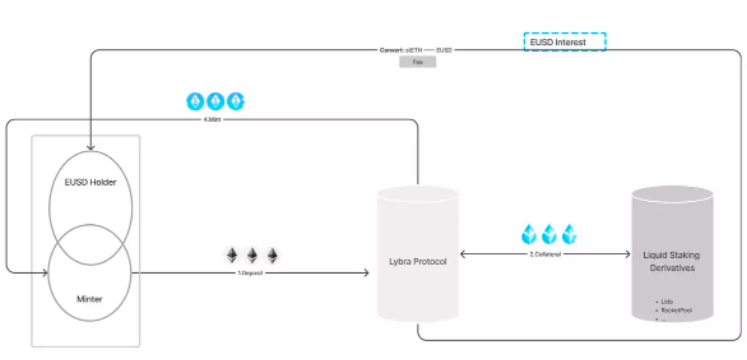
Lybra Finance is a DeFi protocol that allows you to deposit ETH and mint the stablecoin eUSD without paying any fees or borrowing interest. The eUSD held in your account will earn a stable interest rate.
The protocol is currently on the testnet and will soon launch on the Ethereum mainnet.
Testnet link: https://beta.lybra.finance/
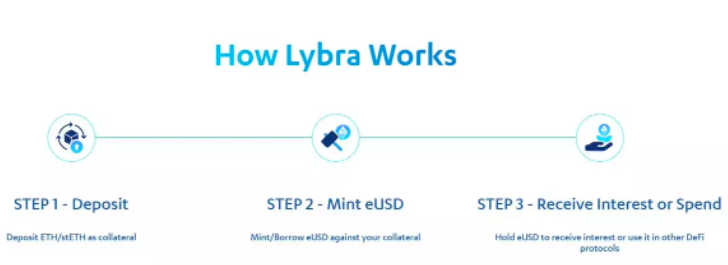
The working principle of Lybra Finance is as follows:
Deposit ETH/stETH as collateral into Lybra;
Mint eUSD;
The held eUSD can earn a yield of 7.2%.
The minted eUSD can also be used in other protocols.
eUSD: The Protocol's Stablecoin
eUSD is a stablecoin pegged to the US dollar, supported by over-collateralized ETH. Simply holding eUSD can generate stable income, with an APY of about 7.2%.
How does eUSD generate interest?
The deposited ETH is automatically converted into stETH through the Lybra protocol. Over time, stETH continues to grow. The yield generated from stETH is converted into eUSD. The yield is then distributed to eUSD holders, with a basic APY of 7.2%.
So, how is the stability of eUSD ensured?
Lybra maintains the stability of eUSD through the following three methods, which are also the basic design of most over-collateralized stablecoins:
Over-collateralization;
Liquidation mechanism;
Arbitrage opportunities.
Over-collateralization
Each eUSD is backed by at least $1.5 worth of stETH as collateral.
Liquidation mechanism
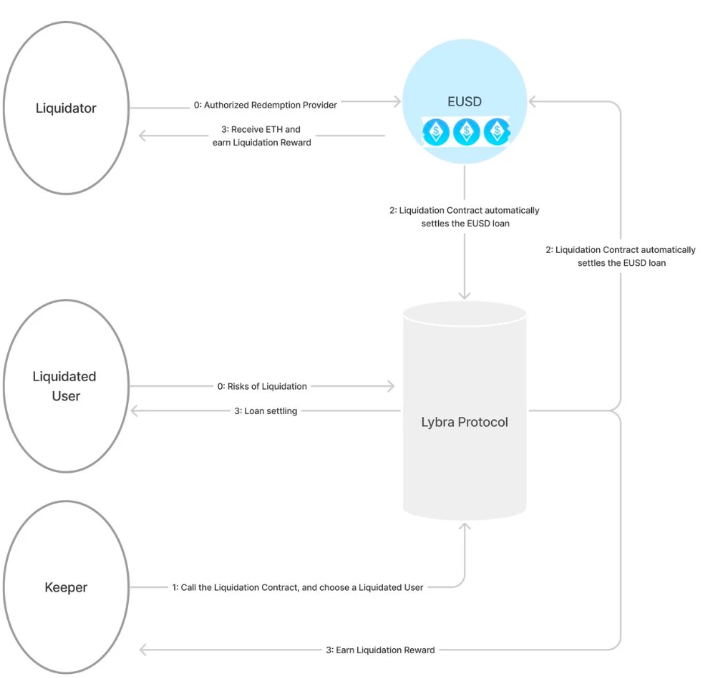
If a user's collateral ratio falls below a safe collateral ratio, any user can voluntarily become a liquidator. They can use the corresponding eUSD to purchase the liquidated portion of the collateralized stETH. This mechanism ensures the stability of eUSD.
Arbitrage opportunities
When the price of eUSD deviates from its $1 peg, arbitrage opportunities arise, allowing users to profit from these price differences.
LBR: The Protocol's Native Token
LBR is the native token of the Lybra protocol. Users holding stLBR can participate in governance and voting while sharing in the protocol's profits.
Users can obtain LBR tokens through the following methods:
- Participating in the Lybra LBR IDO;
- Earning rewards by minting eUSD;
- Becoming an eUSD / ETH liquidity provider.
Protocol Operation Mechanism and User Roles
In the Lybra protocol, users can play the following roles:
- Minters;
- Redemption Providers;
- Liquidators;
- Keepers.
Minters
Users can use their ETH or stETH as collateral to borrow eUSD, earn yields, and repay their debts later. The user's collateral ratio should be above the safe collateral ratio, which is 160%.
Rigid Redemption
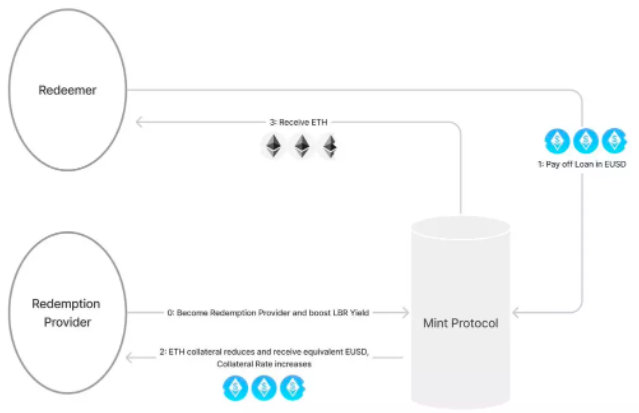
Rigid redemption is the process of exchanging eUSD at face value for ETH, similar to 1 eUSD being equal to 1 dollar. Users can exchange their eUSD for ETH at any time with a fee of 0.05%.
Liquidators
Liquidators are the first line of defense in maintaining the system's viability. By becoming a liquidator, users can use their eUSD to settle any debts of borrowers (Minters) at any time. They maintain the stability and total supply of eUSD.
Keepers
Any third party can run Keepers to monitor the status of each liquidator and minter. When a borrower needs to be liquidated, Keepers can choose to settle immediately using eUSD.
Token Economics
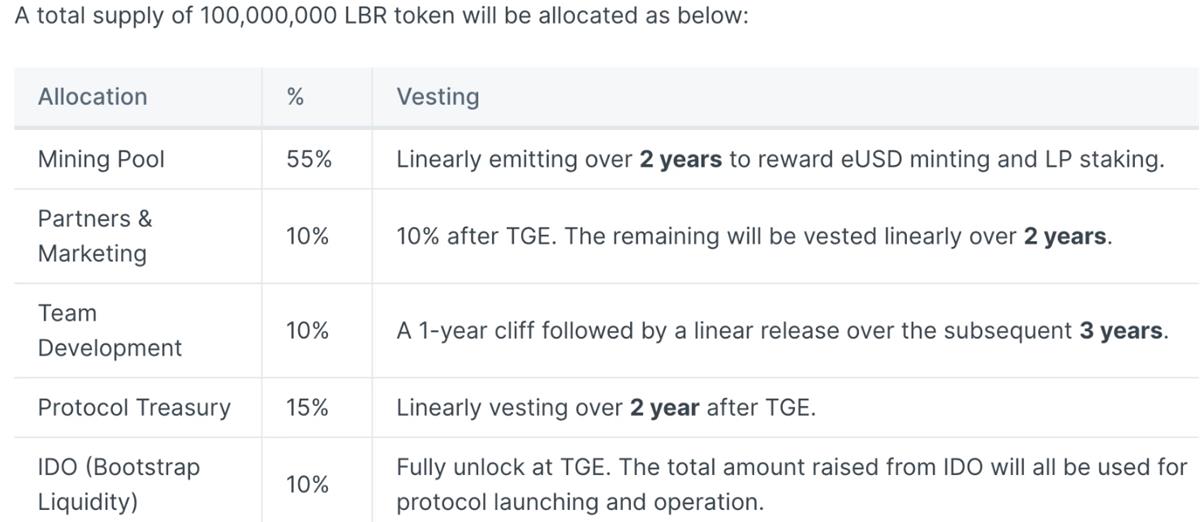
LBR is an ERC-20 governance token with a maximum supply of 1 billion. The token distribution is as follows:
Mining Pool: 55%
Partners and Marketing: 10%
Team Development: 10%
Treasury: 15%
IDO: 10%
Except for the IDO, which is fully unlocked directly, different allocators have almost all a linear unlocking period of over 2 years, as detailed below:
 Risk warning
 Risk warning