







Bankless: EigenLayer Testnet User Guide

 The EigenLayer mainnet is about to launch, and now is the time to become an early adopter.
Original Title: 《How to Try EigenLayer Early》
Author: William Peaster
Compiled by: Kate, Marsbit
The next big thing in the Ethereum staking scene is EigenLayer, a new "restaking" protocol that promises to provide Ethereum stakers with a plethora of new profit opportunities. Today, we will prepare for the arrival of the protocol and potential future airdrops by trying out the basics of EigenLayer on the testnet.
How to Prepare for EigenLayer
EigenLayer is a promising protocol built on Ethereum that enables restaking—a new innovative method for cryptoeconomic security.
In short, restaking allows users to extend the security of their staked ETH or liquid staking tokens (such as Lido's stETH) to other applications on Ethereum, thereby earning additional rewards on top of the ETH staking yields from their services.
Further, the EigenLayer protocol offers two key innovations: pooled security through restaking and free market governance.
- Pooled security allows Ethereum validators to extend the security of their staked ETH to other "modules" on EigenLayer, providing additional income for security and validation work.
- Free market governance enables validators to decide their risk-reward trade-offs by choosing to join or exit various modules, making EigenLayer an open market where Active Validator Services (AVS) can access the pooled security provided by Ethereum validators.
As David Hoffman from Bankless pointed out last week in his article about EigenLayer, this concept of restaking is similar to the old idea of PoW "merged mining," which allows the same hashing power to mine multiple networks simultaneously.
Thus, for proof-of-stake blockchains like Ethereum, restaking allows multiple networks to utilize the same capital stake (i.e., staked ETH) for security at the same time.
For example, consensus protocols built on EigenLayer can use ETH stakers to guarantee security while imposing slashing conditions to mitigate attacks. Anything from bridges to virtual machines can utilize EigenLayer in this way, making the project capable of significantly enhancing the security and profitability of the Ethereum ecosystem!
Current Status of EigenLayer
On April 6, 2023, EigenLayer announced the launch of its first phase testnet, which is the first of three planned launch phases for the protocol.
The first phase testnet is built on the Ethereum Goerli network and specifically focuses on stakers restaking on EigenLayer. Potential users should note that this is an early, non-incentivized testnet, and the code is under active development. Consider this an experiment, because it is an experiment!
In this initial phase, EigenLayer supports liquidity tokens like Lido's stETH and Rocket Pool's rETH for restaking on the platform's contracts, although native ETH restaking will also be supported in the future.
How to Restake on the Testnet
The EigenLayer mainnet is about to launch, so trying out this project on Ethereum's Goerli testnet now will give you a chance to familiarize yourself with its processes and interface. This way, when the project finally goes live, you can be one of the first users to truly engage with it.
In summary, using EigenLayer on the testnet is very straightforward, but you will need an Ethereum wallet and some Goerli ETH (gETH) to pay for gas fees. You can add Goerli to your wallet via Chainlist, and if you need to acquire some testnet ETH, you can use the Goerli Faucet.
Finally, when you're ready to proceed, you can follow these three steps:
Obtain testnet stETH - The easiest way is to switch your wallet to the Goerli network and send a small amount of gETH to Lido's address 0x1643E812aE58766192Cf7D2Cf9567dF2C37e9B7F, which is a smart contract that will automatically send you an equivalent amount of testnet stETH in return!
Visit EigenLayer at https://goerli.eigenlayer.xyz/, connect your wallet, and switch to the Goerli network.
Deposit - Click on the "Lido staking Ether (stETH)" option, enter the amount of testnet stETH you wish to deposit, and then approve and confirm the transaction with your wallet.
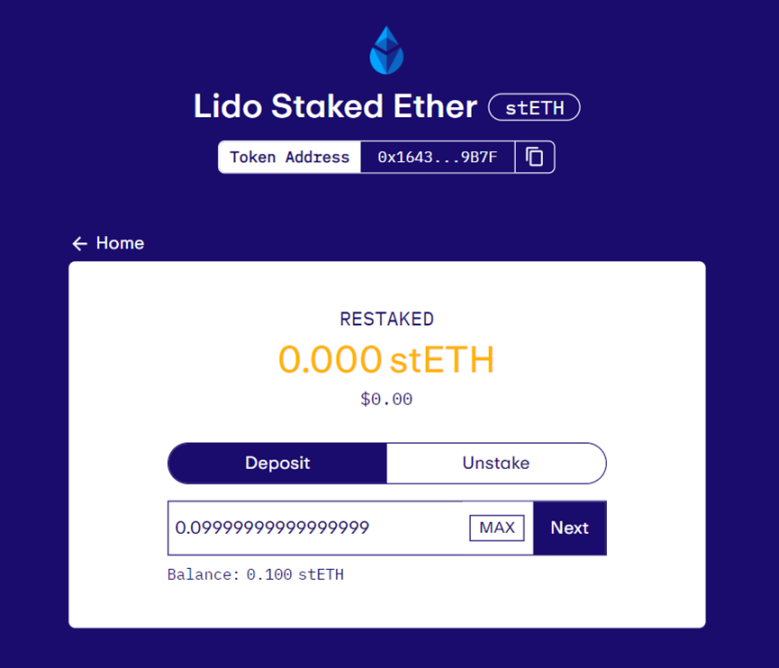
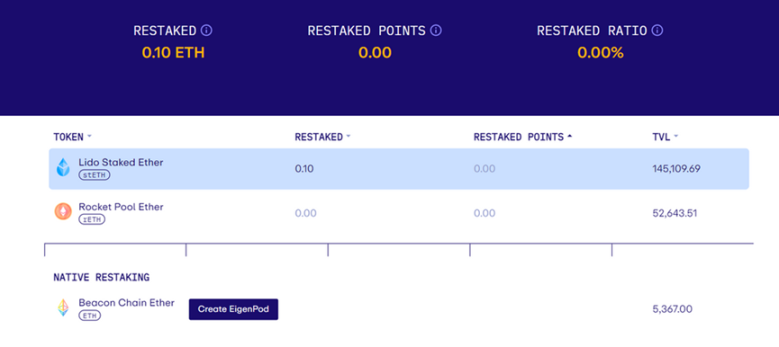
That's it! That's the gist of restaking through EigenLayer, nothing too crazy, right? Also, remember that you can unstake the testnet stETH through the same interface as needed.
The Benefits of Being Early
In the near future, being ahead of the EigenLayer curve will be advantageous.
Why? Because being one of the first participants in the mainnet EigenLayer deployment will come with significant benefits.
One of these benefits is early access to projects launching on EigenLayer, as certain services may limit their initial restaking amounts, leaving latecomers on the sidelines.
Therefore, if you practice a couple of times on the testnet now, you will be ready to take immediate action and be among the first official users once EigenLayer goes live on the mainnet!
 Risk warning
 Risk warning