Scan to download
BTC $76,979.31 -1.70%
ETH $2,291.96 -3.14%
BNB $623.91 -1.82%
XRP $1.39 -2.47%
SOL $84.24 -2.96%
TRX $0.3260 +0.76%
DOGE $0.0979 -1.15%
ADA $0.2458 -2.61%
BCH $448.80 -1.20%
LINK $9.22 -2.66%
HYPE $41.65 -0.73%
AAVE $96.19 -0.67%
SUI $0.9244 -2.31%
XLM $0.1646 -3.76%
ZEC $351.23 -2.15%
BTC $76,979.31 -1.70%
ETH $2,291.96 -3.14%
BNB $623.91 -1.82%
XRP $1.39 -2.47%
SOL $84.24 -2.96%
TRX $0.3260 +0.76%
DOGE $0.0979 -1.15%
ADA $0.2458 -2.61%
BCH $448.80 -1.20%
LINK $9.22 -2.66%
HYPE $41.65 -0.73%
AAVE $96.19 -0.67%
SUI $0.9244 -2.31%
XLM $0.1646 -3.76%
ZEC $351.23 -2.15%

uma

The Humanity Foundation announced adjustments to the H token vesting plan and set a deadline, with some institutions publicly disclosing their choice to unlock at a discount immediately

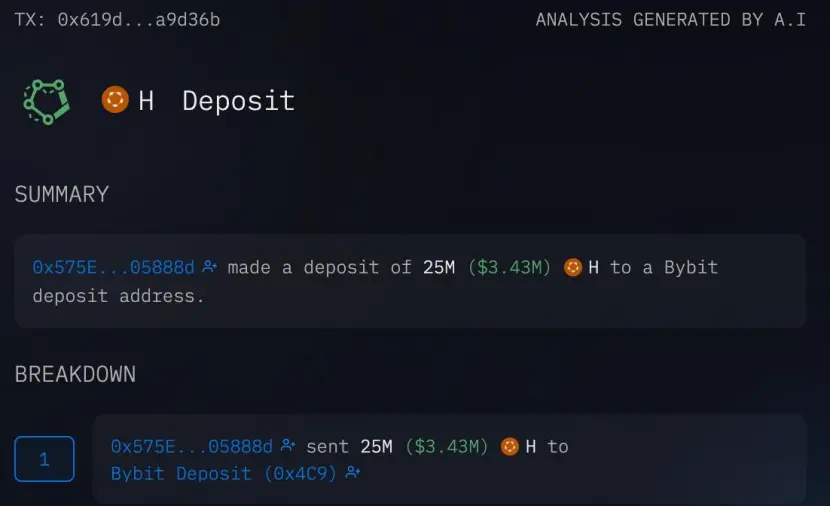
The Humanity Foundation has recently made significant adjustments to the $H token allocation plan, requiring investors to make a final choice between two options by April 26 at 09:00 UTC: one, extend the distribution, pushing the Cliff to September 25, 2026, and changing to equal distribution over 12 quarters; two, a 3:10 discounted immediate unlock, replacing the original 16,666,666 tokens with 5,000,000 $H (a 70% reduction), to be fully distributed on June 25, 2026.It is understood that the Humanity Foundation has sent adjustment notifications to over 100 investors. Early investment firm Trix Ventures has publicly disclosed its choice of the discounted immediate unlock.It is reported that this firm invested during the project's valuation phase of approximately $60 million, and even after the 3:10 discounted replacement, it can still achieve about 7 times return. Notably, the Humanity Protocol previously reached an in-depth cooperation with payment giant Mastercard, and the project's fundamentals have received endorsement from traditional financial institutions. The on-chain identity verification sector it belongs to is currently in its early market stage, but with the continuous expansion of AI-generated content and automated accounts, the demand for on-chain real identity verification is widely believed to grow exponentially, giving this sector long-term potential to become a leading project in the Web3 infrastructure field.The project is about to face a test of significant selling pressure from a one-time massive unlock, and whether it can grow explosively alongside the AI sector is crucial. Analysts point out that choosing the one-time unlock on June 25 is a safer decision. In the current market cycle, "certain liquidity" far outweighs paper numbers. The deferred plan extends the cycle to 3 years, with huge uncertainties regarding the protocol's survival and team stability.From a market structure perspective, June 25 faces obvious concentrated selling pressure risks: the Sablier contract release node is transparent on-chain, and quantitative and short-selling funds will precisely target this node; institutions may lock in profits by hedging in advance during the two-month window; market makers may withdraw buy depth in advance, causing the actual realization value to be less than 10% of the nominal value. Historically, large-scale concentrated unlocks of Starknet (STRK) and ApeCoin (APE) have triggered severe selling pressure, with the former dropping over 95% from its peak and the latter declining 77% within 7 months.

Satsuma Technology's stock price fell 99%, Pantera urges liquidation, DFDV makes its first investment in Asia in Allied Architects

According to BBX data, the first public collapse case in the corporate digital asset reserve sector occurred yesterday, and on the same day, the crypto industry jointly issued the largest legislative mobilization of the year. Several listed companies disclosed their latest reserve actions, with the core dynamics as follows:Satsuma Technology Plc (LSE: $SATS) reported by Bloomberg on April 23 that digital asset investment firm Pantera Capital (holding approximately 6.7%) is pressuring the company, along with other shareholders, to liquidate all 646 BTC (current market value approximately $50 million) and return the cash to shareholders. The company's executive chairman, Ranald McGregor-Smith, confirmed that they have received requests from shareholders for capital return, stating that they are "evaluating options."DeFi Development Corp. (NASDAQ: $DFDV) announced that its Treasury Accelerator Program has completed a strategic equity investment in Japanese listed company Allied Architects, Inc. (TSE: 6081), marking the company's first entry into the Asian market. As of recently, the company holds approximately 2.2 million SOL (market value approximately $195 million), using "SOL per Share (SPS)" as a core performance indicator.H100 Group AB (OTCMKTS: $HOGPF) upgraded the letter of intent (LOI) signed in March to a binding share purchase agreement, intending to acquire a total of approximately 2,450 BTC reserves from Moonshot AS and Never Say Die AS; upon completion, the company's BTC holdings are expected to rise to approximately 3,501 BTC, with the transaction structure being all-stock consideration (BTC for BTC, no cash involved). Existing shareholders are expected to hold about 30% after completion, with the delivery expected to be completed by August 2026.Remixpoint, Inc. (TSE: 3825) recently increased its holdings by 20.0312 BTC (approximately $1.57 million), bringing its total BTC holdings to 1,431.33 BTC, with a current paper profit of approximately $21.28 million; the company also plans to purchase approximately $3.13 million in additional crypto assets.

The State Duma of Russia has passed the digital currency bill on its first reading, granting the central bank control over market access and transaction regulation

The State Duma of Russia (the lower house of parliament) has passed the "Digital Currency and Digital Rights Bill" in the first reading, marking a key step towards the legalization of cryptocurrency assets in the country.According to the bill, the Bank of Russia will become the core regulatory body for the cryptocurrency market, responsible for issuing licenses, approving or prohibiting related transactions, and defining the legality of transactions. The bill proposes to classify cryptocurrencies as "property," but explicitly prohibits their use as a means of payment domestically, with the ruble remaining the only legal tender. However, in the context of Western sanctions, cryptocurrency assets can be used for cross-border trade settlements, including service payments, intellectual property transfers, and other scenarios.In addition, the bill allows Russian residents to legally invest in cryptocurrency assets through licensed institutions, but will implement a tiered investor system, setting testing and annual investment limits for ordinary investors (with a suggested cap of 300,000 rubles). Initially, only high-market-cap mainstream assets like Bitcoin and Ethereum will be allowed for trading, with a whitelist established by the central bank. The bill is expected to be formally passed and come into effect by July 2026 at the latest. However, some lawmakers and banking industry figures have criticized the overly strict regulations, which may affect market activity and even lead to funds remaining in the gray market. At the same time, accompanying legislation is also proposed to introduce criminal penalties, with a maximum sentence of 7 years in prison for illegal cryptocurrency trading.

The National Internet Information Office and four other departments jointly announced the "Interim Measures for the Management of Humanized Interactive Services in Artificial Intelligence."

The National Internet Information Office, the National Development and Reform Commission, the Ministry of Industry and Information Technology, the Ministry of Public Security, and the State Administration for Market Regulation jointly announced the "Interim Measures for the Management of Humanized Interactive Services in Artificial Intelligence," which will take effect on July 15, 2026.The "Measures" implement the concept of people-oriented and benevolent intelligence, clarifying the principle that the country insists on balancing development and security, promoting innovation and legal governance, encouraging innovative development of humanized interactive services, and implementing inclusive, prudent, and classified regulatory measures for humanized interactive services; it proposes measures to promote humanized interactive services, clarifying support for technological research and development innovation, and encouraging orderly expansion of applications in related fields such as cultural dissemination and elderly companionship.It stipulates the basic requirements for providing humanized interactive services, clearly stating that activities that generate harm to national security, honor, and interests, incite subversion of state power, or overthrow the socialist system are prohibited, and specifies the safety management obligations of humanized interactive service providers; it improves the protection system for the rights and interests of internet users, stipulating the obligations of humanized interactive service providers regarding the protection of minors, the elderly, and personal information.In addition, the "Measures" also stipulate systems for safety assessments, algorithm filing, and guiding the promotion of the construction of safe service platforms for artificial intelligence sandboxes.
app_icon
ChainCatcher Building the Web3 world with innovations.