Scan to download
BTC $76,908.81 -1.74%
ETH $2,292.87 -3.16%
BNB $624.00 -1.87%
XRP $1.39 -2.73%
SOL $84.17 -3.02%
TRX $0.3258 +0.59%
DOGE $0.0979 -1.52%
ADA $0.2457 -2.68%
BCH $448.44 -1.29%
LINK $9.22 -2.77%
HYPE $41.60 -0.96%
AAVE $95.81 -0.94%
SUI $0.9246 -2.26%
XLM $0.1647 -3.72%
ZEC $354.44 -1.02%
BTC $76,908.81 -1.74%
ETH $2,292.87 -3.16%
BNB $624.00 -1.87%
XRP $1.39 -2.73%
SOL $84.17 -3.02%
TRX $0.3258 +0.59%
DOGE $0.0979 -1.52%
ADA $0.2457 -2.68%
BCH $448.44 -1.29%
LINK $9.22 -2.77%
HYPE $41.60 -0.96%
AAVE $95.81 -0.94%
SUI $0.9246 -2.26%
XLM $0.1647 -3.72%
ZEC $354.44 -1.02%

business

Illustration: Fireblocks' 30 Web3 business partners: Who is driving the $200 billion stablecoin flow?

The Web3 asset data platform RootData has outlined 30 business partners of Fireblocks, spanning multiple key areas such as DeFi protocols, payment settlement, compliance analysis, trading institutions, and multi-chain infrastructure:Settlement Layer: Represented by Circle, TripleA, and Lynq, responsible for stablecoin issuance and payment clearing.Liquidity and Trading Layer: Includes market makers and trading institutions such as Wintermute, Amber Group, GSR, and Wootton, responsible for fund distribution and market depth.On-chain Application Layer: Covers DeFi and application tools like Aave, Morpho, and MetaMask, which support the actual operation scenarios of funds.Compliance and Risk Control Layer: Service providers like Chainalysis, Elliptic, and Coincover form an important supplement to its regulatory adaptation capabilities.By 2025, Fireblocks is expected to handle over $200 billion in stablecoin transactions per month, a year-on-year increase of 300%. Fireblocks' positioning is evolving from a "custody and security service provider" to a central hub for on-chain fund flows and institutional asset circulation.Currently, Fireblocks supports over 150 public blockchain networks, and its partnership network has expanded to over 2,500 global institutional participants, including banks, asset management firms, exchanges, market makers, and fintech companies. Related compilation: Fireblocks Web3 Partner Network Compilation (Continuously Updated)Cryptocurrency projects actively showcasing their partner networks have become a key way to enhance transparency and market trust. It is reported that RootData welcomes Web3 project parties to claim information and continues to track and open more project business relationship disclosure channels. The platform has continuously released multiple issues of the cryptocurrency project ecosystem map, nominating Web3 ecosystem partners for upstream clients such as Visa, Mastercard, and Coinbase.If you wish to nominate your project in future ecosystem maps, please fill out the RootData 2026 Industry Ecosystem Mapping form to supplement your important clients and partners.

The Japanese Financial Services Agency is promoting the transition of the crypto asset business law and simultaneously launching three stablecoin payment pilot experiments

According to market news, at the "9th BCCC Collaborative Day" held on April 21, 2026, Shigeru Shimizu, the head of the Risk Analysis Division of the Financial Services Agency (FSA) of Japan, delivered a special speech revealing significant progress in cryptocurrency regulation. The FSA has submitted a bill to the extraordinary Diet, proposing to transition cryptocurrencies from the Payment Services Act to the Financial Instruments and Exchange Act, mainly involving four core aspects: regulations on information disclosure, the establishment of new classifications for independent operators, strengthening penalties for unregistered operators, and preparing regulations against insider trading.At the same time, the FSA is advancing three "Payment Innovation Projects (PIP)" empirical experiments: first, a cross-border payment trial using yen stablecoins involving three major banks; second, on-chain settlement of securities such as government bonds, corporate bonds, and stocks based on blockchain, aiming for 24/7 continuous trading; third, an interbank tokenized deposit transfer experiment that just received support on April 3 of this month, which will be promoted in conjunction with the Bank of Japan's central bank digital currency tokenization sandbox project. Mr. Shimizu stated that blockchain has great potential in enhancing the convenience of financial services and diversifying products, and the FSA will continue to promote institutional development and practical support.

Illustration of Zero Hash's 28 Web3 business partners: Connecting cryptocurrency and fiat currency settlement with compliant licenses

The Web3 asset data platform RootData has outlined the Web3 business partners of Zero Hash, whose partners cover key areas such as asset management institutions, payment channels, public chain infrastructure, and stablecoin systems, and are building a cooperative network centered on compliance clearing and asset access.Structurally, Zero Hash is committed to becoming a B-end crypto financial infrastructure provider, offering institutions a one-stop capability of "fiat currency → crypto assets → multi-chain circulation → stablecoin settlement":Upstream, it connects asset management and financial platforms such as Morgan Stanley, Franklin Templeton, and Republic; on the funding entry side, it interfaces with payment and fiat channels like Stripe, Ramp, and Transak; at the infrastructure level, it covers multi-chain infrastructures such as Ethereum, Solana, Polygon, Avalanche, and Aptos; at the same time, it connects with stablecoin systems like Circle, Tether, Paxos, as well as PYUSD and RLUSD, completing clearing and settlement support.In addition, Zero Hash, as one of the few infrastructure providers holding money transmission licenses (MTL) in multiple U.S. states and possessing complete regulatory framework adaptation capabilities, has a very clear common characteristic among its partners: funding entry (banks/payments), asset carriers (stablecoins/public chains), or distribution platforms (financial products/applications). Related collection 【Zero Hash Web3 Partner Network Collection (Continuously Updated)】Crypto projects actively showcasing their partner networks has become a key way to enhance transparency and market trust. It is reported that RootData welcomes Web3 project parties to claim data and continues to track and open more project business relationship disclosure channels. The platform has continuously released multiple versions of the crypto project ecosystem map, nominating Web3 ecological partners for upstream clients such as Visa, Mastercard, and Coinbase.If you wish to nominate your project in future ecosystem maps, please fill out the 【RootData 2026 Industry Ecosystem Mapping】 form to supplement your important clients and partners.

first_img OKX Global Chief Business Officer Lennix Lai: In the future, one person equipped with five AI agents can rival an entire institutional investment team

ChainCatcher reported live that Lennix Lai, the Global Chief Business Officer of OKX, delivered a keynote speech at the 2026 Hong Kong Web3 Carnival. He pointed out that AI Agents are changing the way users interact with wallets and blockchains. OKX is building a wallet operating system from scratch that serves not only human users but also AI Agents: On-chain OS.This system is built on the existing capabilities of the OKX wallet, which includes 1.2 billion API calls per day, over $300 million in daily trading volume, support for more than 60 chains, and aggregation of 500 DEXs. Users can issue commands in natural language, such as "automatically exchange to USDC when ETH drops below 2000," and the Agent will automatically track prices, compare quotes from different DEXs, route the optimal path, and execute the trade upon human confirmation.He emphasized that Agents also need to trade and pay each other, thus requiring an efficient and low-cost microtransaction settlement layer. OKX's Layer 2 network, X Layer, plays this role with zero gas fees and instant finality, and it supports the X402 payment protocol and on-chain Agent identity registration. He stated that future financial infrastructure will no longer serve only top professionals; an individual working with five different Agents can achieve results comparable to those of large institutional investment teams, which is the most significant meaning of AI in the cryptocurrency industry.

Illustration of 78 Web3 Business Partners in Anchorage: A Financial Bridge Connecting Wall Street and the On-Chain World

The Web3 asset data platform RootData has outlined 78 business partners of Anchorage, including over 30 DeFi protocols, more than 20 blockchain infrastructure projects, as well as various stablecoins and payment settlement networks, covering the complete path from asset issuance to on-chain operations.Represented by institutions like BlackRock, products such as ETFs bring funds into the crypto market, after which Anchorage assumes custody and compliance responsibilities. These assets are then deployed on-chain, participating in liquidity operations and yield generation through DeFi protocols, stablecoin systems, and infrastructure networks. Ultimately, they flow back into the traditional financial system through OTC, trading, and clearing paths.In this process, Anchorage's role is not just "custody," but a key node throughout the entire lifecycle of funds, with its upstream and downstream including crypto-native institutions such as A16z, Blockchain Capital, Electric Capital, and Defiance, as well as DeFi protocols, L1/L2 networks, stablecoins, and clearing and settlement systems, along with fintech companies like AngelList and Series Financial, as well as payment companies and core banking systems.Anchorage's partner strategy emphasizes "key path coverage," ensuring that funds have corresponding infrastructure at every stage. As compliant entry points like ETFs gradually open up, the crypto market shifts towards asset allocation-driven strategies, and bridge-type institutions like Anchorage are moving from the background to the core. Related compilation: Anchorage Web3 Partner Network Compilation (continuously updated)Crypto projects actively showcasing their partner networks have become a key way to enhance transparency and market trust. It is reported that RootData welcomes Web3 project parties to claim data and continues to track and open more project business relationship disclosure channels. The platform has continuously released multiple editions of crypto project ecological maps, nominating Web3 ecological partners for upstream clients such as Visa, Mastercard, and Coinbase.If you wish to nominate your project in future ecological maps, please fill out the RootData 2026 Industry Ecosystem Mapping form to supplement your important clients and partners.

Illustration of Upbit's 10 Web3 Business Partners: Exchange Model Shaped by Korean Regulations

The Web3 asset data platform RootData has outlined Upbit's business partners, which are relatively limited and mainly focused on areas such as blockchain infrastructure and compliance services. This is closely related to South Korea's unique and strict regulatory framework: under a system environment centered on real-name systems, VASP regulation, and anti-money laundering, exchanges are required to take greater responsibility for the flow of funds and user identities, making Upbit more inclined to develop its own systems and build localized capabilities rather than extensively introducing external partners.From the disclosed structure, on the technical side, infrastructure capabilities are strengthened through Lambda256, Aptos, and others; on the compliance level, service providers such as VerifyVASP, Chainalysis, and Crystal Intelligence are introduced; and supplementary funding and liquidity are provided through Circle and Naver Pay. Additionally, Upbit quickly built trading capabilities relying on its cooperation with Bittrex since its launch in 2017.On the branding side, Upbit has explored NFT entertainment collaborations with Hybe and has laid out plans in esports (LCK) and signed top players like Faker, while also becoming a primary partner of the Korean Sports Council. However, as the popularity of NFTs and the metaverse has declined, the influence of related entertainment collaborations has weakened. Related compilation: [Upbit Web3 Partner Network Compilation (continuously updated)](https://cn

Illustration of Binance's 33 Web3 business partners: The self-circulating system of the crypto liquidity center

Web3 asset data platform RootData has outlined Binance's business partners, covering key aspects such as stablecoins, payment channels, blockchain infrastructure, risk control compliance, and application scenarios, forming a cryptocurrency liquidity center centered around "capital flow."Binance, as a self-circulating capital system, has funds entering, flowing, consuming, and settling all within the same system: At the base level, Tether and Circle provide core liquidity; on the entry side, PayPal, VISA, Mastercard, and others continuously introduce new funds; on the blockchain and trading layer, Aptos, TRON, and others enhance asset richness and circulation efficiency; at the same time, Binance maintains compliance capabilities through TRM Labs, Elliptic, and others.All partners serve around "liquidity efficiency." The role of scenario-based partners like Travala, predict.fun, and Four.Meme is to continuously extend the lifecycle of funds within the system, creating a sustainable cycle. In terms of brand strategy, Binance focuses on areas such as F1 (Alpine) and football, and is committed to promoting cryptocurrency education.In addition, Binance is also strengthening the connectivity of the "tool layer," besides the early acquisition of CoinMarketCap, it is also forming synergies with data and analysis tools like RootData and Bubblemaps, gradually incorporating information flow and decision flow beyond capital flow into its ecosystem. Related collection 【Binance Web3 Partner Network Collection (continuously updated)】Note: This statistic does not include Binance token airdrop partners (including Alpha / Holder airdrops and staking yield projects), mainly due to the large number of related collaborations, which are more inclined towards incentives and do not constitute the core business structure.Cryptocurrency projects actively showcasing their partner networks has become a key way to enhance transparency and market trust. It is reported that RootData welcomes Web3 project parties to claim data, and continues to track and open more project business relationship disclosure channels. The platform has continuously released multiple editions of cryptocurrency project ecological maps, nominating Web3 ecosystem partners for upstream clients such as Visa, Mastercard, and Coinbase.If you wish to nominate your project in future ecological maps, please fill out the 【RootData 2026 Industry Ecosystem Mapping】 form to supplement your important clients and partners.

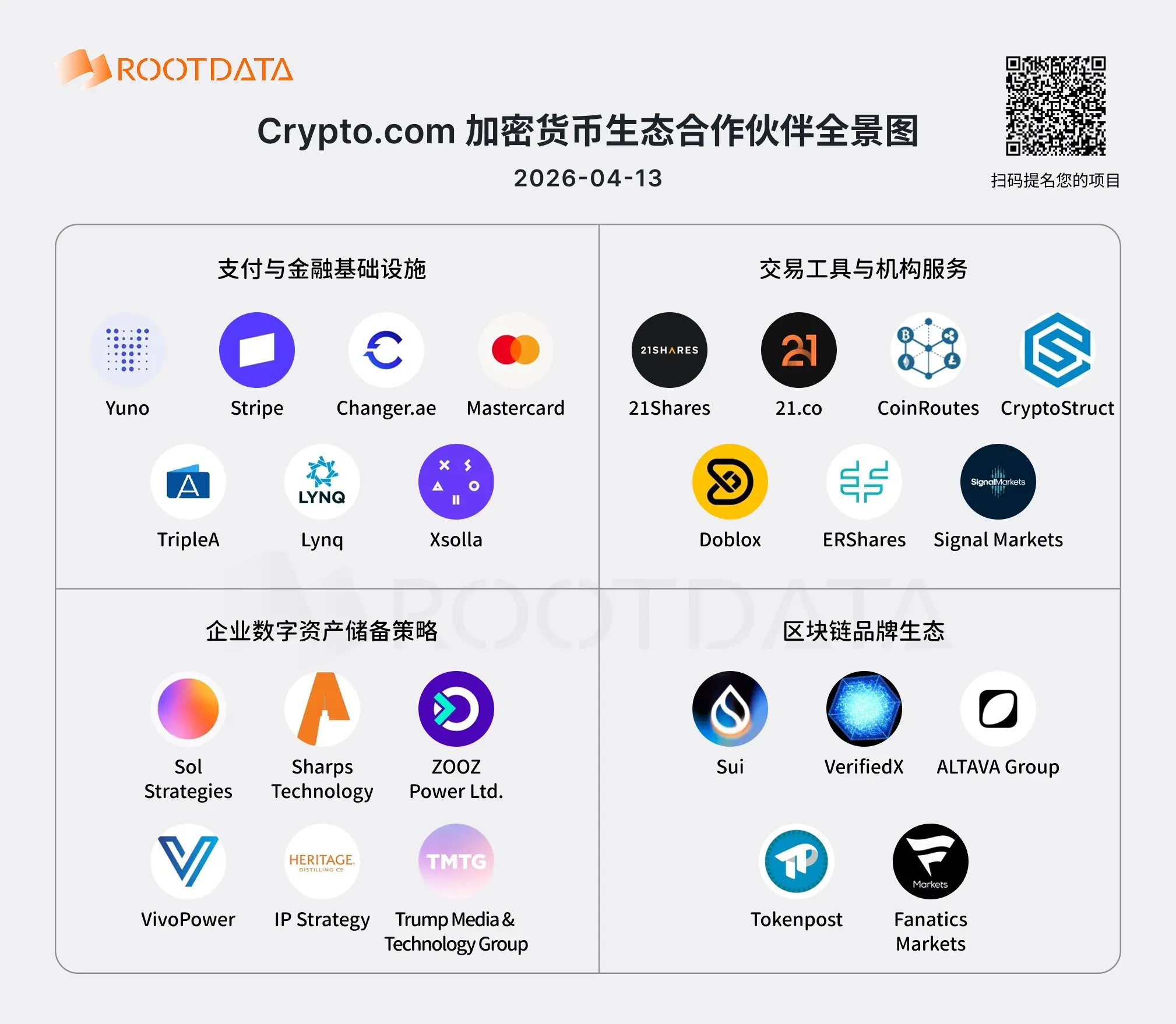
Infographic: Crypto.com’s 25 Web3 Business Partners: Full-stack Expansion from Payment Infrastructure to Brand Ecosystem

The Web3 asset data platform RootData has outlined the business partners of Crypto.com. Its strategy goes beyond exchange expansion, advancing through multiple paths such as payments, custody, and brand collaborations, aiming to create a comprehensive digital asset platform covering both institutional and consumer ends.Payment Infrastructure: Crypto.com has integrated with Stripe, Mastercard, Yuno, TripleA, Lynq, etc., covering the complete link from checkout crypto payments to institutional-level real-time clearing.Institutional Trading and Custody: VerifiedX has entrusted Crypto.com with institutional custody for its $1.5 billion digital assets; CoinRoutes provides smart order routing, CryptoStruct connects high-frequency trading, and Doblox offers AI trading terminals.Corporate Crypto Treasury: Crypto.com collaborates with several Nasdaq-listed companies executing treasury strategies, including SOL Strategies, Sharps Technology, and IP Strategy.On the brand side, Crypto.com has formed deep ties with top sports IPs—renewing its partnership with F1 until 2030 and sponsoring the Miami Grand Prix, as well as UEFA Champions League, UFC, NBA Philadelphia 76ers, AFL, and South American CONMEBOL; the long-term partnership with the LeBron James Family Foundation marks an extension of its brand collaboration into the celebrity family philanthropy sector.Additionally, Crypto.com has signed collaborations in the Middle East with Dubai Islamic Bank, DMCC, e& money, Tawasal Al Khaleej super app, and Emarat gas station network, becoming an important participant in the local digital asset compliance ecosystem. Related compilation: 【Crypto.com Web3 Partner Network Compilation (Continuously Updated)】Cryptocurrency projects actively showcasing their partner networks have become a key way to enhance transparency and market trust. It is reported that RootData welcomes Web3 project parties to claim data and continues to track and open more project business relationship disclosure channels. The platform has continuously released multiple issues of the cryptocurrency project ecosystem map, nominating Web3 ecosystem partners for upstream clients such as Visa, Stripe, and Coinbase.If you wish to nominate your project in future ecosystem maps, please fill out the 【RootData 2026 Industry Ecosystem Mapping】 form to supplement your important clients and partners.
Infographic: Crypto.com’s 25 Web3 Business Partners: Full-stack Expansion from Payment Infrastructure to Brand Ecosystem
app_icon
ChainCatcher Building the Web3 world with innovations.