Scan to download
BTC $77,034.02 -1.32%
ETH $2,280.59 -2.83%
BNB $621.94 -1.69%
XRP $1.39 -2.63%
SOL $84.26 -2.61%
TRX $0.3248 +0.40%
DOGE $0.0974 -1.56%
ADA $0.2448 -3.06%
BCH $451.84 +0.02%
LINK $9.21 -2.90%
HYPE $41.88 +1.26%
AAVE $97.22 +1.55%
SUI $0.9228 -2.51%
XLM $0.1656 -3.27%
ZEC $356.59 +0.63%
BTC $77,034.02 -1.32%
ETH $2,280.59 -2.83%
BNB $621.94 -1.69%
XRP $1.39 -2.63%
SOL $84.26 -2.61%
TRX $0.3248 +0.40%
DOGE $0.0974 -1.56%
ADA $0.2448 -3.06%
BCH $451.84 +0.02%
LINK $9.21 -2.90%
HYPE $41.88 +1.26%
AAVE $97.22 +1.55%
SUI $0.9228 -2.51%
XLM $0.1656 -3.27%
ZEC $356.59 +0.63%

ust

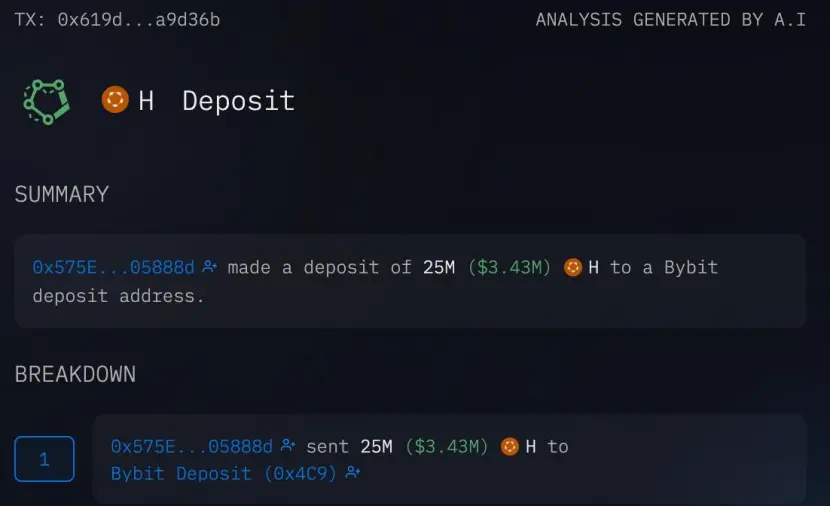
The Humanity Foundation announced adjustments to the H token vesting plan and set a deadline, with some institutions publicly disclosing their choice to unlock at a discount immediately

The Humanity Foundation has recently made significant adjustments to the $H token allocation plan, requiring investors to make a final choice between two options by April 26 at 09:00 UTC: one, extend the distribution, pushing the Cliff to September 25, 2026, and changing to equal distribution over 12 quarters; two, a 3:10 discounted immediate unlock, replacing the original 16,666,666 tokens with 5,000,000 $H (a 70% reduction), to be fully distributed on June 25, 2026.It is understood that the Humanity Foundation has sent adjustment notifications to over 100 investors. Early investment firm Trix Ventures has publicly disclosed its choice of the discounted immediate unlock.It is reported that this firm invested during the project's valuation phase of approximately $60 million, and even after the 3:10 discounted replacement, it can still achieve about 7 times return. Notably, the Humanity Protocol previously reached an in-depth cooperation with payment giant Mastercard, and the project's fundamentals have received endorsement from traditional financial institutions. The on-chain identity verification sector it belongs to is currently in its early market stage, but with the continuous expansion of AI-generated content and automated accounts, the demand for on-chain real identity verification is widely believed to grow exponentially, giving this sector long-term potential to become a leading project in the Web3 infrastructure field.The project is about to face a test of significant selling pressure from a one-time massive unlock, and whether it can grow explosively alongside the AI sector is crucial. Analysts point out that choosing the one-time unlock on June 25 is a safer decision. In the current market cycle, "certain liquidity" far outweighs paper numbers. The deferred plan extends the cycle to 3 years, with huge uncertainties regarding the protocol's survival and team stability.From a market structure perspective, June 25 faces obvious concentrated selling pressure risks: the Sablier contract release node is transparent on-chain, and quantitative and short-selling funds will precisely target this node; institutions may lock in profits by hedging in advance during the two-month window; market makers may withdraw buy depth in advance, causing the actual realization value to be less than 10% of the nominal value. Historically, large-scale concentrated unlocks of Starknet (STRK) and ApeCoin (APE) have triggered severe selling pressure, with the former dropping over 95% from its peak and the latter declining 77% within 7 months.

Illustration: Fireblocks' 30 Web3 business partners: Who is driving the $200 billion stablecoin flow?

The Web3 asset data platform RootData has outlined 30 business partners of Fireblocks, spanning multiple key areas such as DeFi protocols, payment settlement, compliance analysis, trading institutions, and multi-chain infrastructure:Settlement Layer: Represented by Circle, TripleA, and Lynq, responsible for stablecoin issuance and payment clearing.Liquidity and Trading Layer: Includes market makers and trading institutions such as Wintermute, Amber Group, GSR, and Wootton, responsible for fund distribution and market depth.On-chain Application Layer: Covers DeFi and application tools like Aave, Morpho, and MetaMask, which support the actual operation scenarios of funds.Compliance and Risk Control Layer: Service providers like Chainalysis, Elliptic, and Coincover form an important supplement to its regulatory adaptation capabilities.By 2025, Fireblocks is expected to handle over $200 billion in stablecoin transactions per month, a year-on-year increase of 300%. Fireblocks' positioning is evolving from a "custody and security service provider" to a central hub for on-chain fund flows and institutional asset circulation.Currently, Fireblocks supports over 150 public blockchain networks, and its partnership network has expanded to over 2,500 global institutional participants, including banks, asset management firms, exchanges, market makers, and fintech companies. Related compilation: Fireblocks Web3 Partner Network Compilation (Continuously Updated)Cryptocurrency projects actively showcasing their partner networks have become a key way to enhance transparency and market trust. It is reported that RootData welcomes Web3 project parties to claim information and continues to track and open more project business relationship disclosure channels. The platform has continuously released multiple issues of the cryptocurrency project ecosystem map, nominating Web3 ecosystem partners for upstream clients such as Visa, Mastercard, and Coinbase.If you wish to nominate your project in future ecosystem maps, please fill out the RootData 2026 Industry Ecosystem Mapping form to supplement your important clients and partners.

The conflict has pushed oil prices to rise continuously, and Gate's crude oil contract trading scale and liquidity are among the top in the industry

Due to the ongoing escalation of the US-Iran conflict and restrictions on transportation in the Strait of Hormuz, international oil prices continue to rise strongly, experiencing the longest consecutive increase since January. Data shows that Brent crude oil (XBRUSDT) on the Gate platform is priced at $99.78, an increase of about 2.31%; WTI crude oil (XTIUSDT) is priced at $96.62, an increase of about 2.22%. Against the backdrop of rising oil prices, the trading activity of related derivatives has also increased.According to Coinglass data, the 24-hour trading volume of WTI crude oil (XTIUSDT) on the Gate platform reached $20.08 million, with a position size of about $4.53 million, ranking first among all exchanges; the 24-hour trading volume of Brent crude oil (XBRUSDT) reached $10.92 million, with a position of about $3.81 million, also ranking first. Driven by high volatility, market participation continues to rise, further highlighting Gate's advantages in liquidity and trading depth in the energy derivatives sector.Gate Contracts has pioneered the commodity contract sector, covering perpetual contract trading for XBRUSDT (Brent crude oil), XTIUSDT (WTI crude oil), and NG (natural gas), providing 24/7 trading, USDT settlement, and up to 100x leverage, helping users with cross-market asset allocation and strategic layout in volatile markets.

Morgan Stanley launches a stablecoin reserve fund, positioning itself as a reserve manager for the stablecoin industry

Morgan Stanley's investment management division, MSIM, announced the launch of a stablecoin reserve portfolio fund (MSNXX), which is a government money market fund designed specifically for stablecoin issuers. It aims to provide a regulated and secure storage place for reserves held by issuers that back their tokenized fiat currency versions.The fund only invests in the safest and most liquid instruments, such as U.S. Treasury bills (short-term loans to the U.S. government) and repurchase agreements (overnight loans secured by similar government securities), both of which aim for capital preservation. The fund's target net asset value is $1, meaning that the invested capital retains the same value upon redemption, avoiding price fluctuations; at the same time, the fund offers daily liquidity, allowing investors to redeem funds on any trading day without a waiting period or penalties.Currently, the market capitalization of stablecoins has reached $316 billion, with tokens pegged to the U.S. dollar, such as Tether and USDC, holding the majority share. Morgan Stanley's launch of the fund coincides with the advancement of the GENIUS Act in Congress. If passed, this act would legally require stablecoin issuers to back their tokens with high-quality liquid assets such as Treasury bills and cash-like instruments, and they must be held through regulated instruments. Thus, the fund is positioned to take on reserve management business ahead of regulatory mandates.Additionally, Morgan Stanley Investment Management recently launched the Morgan Stanley Bitcoin Trust (MSBT), which is a cryptocurrency ETP that tracks Bitcoin, with custodial and fund management services provided by BNY Mellon. It has also collaborated with BNY Mellon to launch tokenized DAP class shares of an institutional liquidity fund Treasury securities portfolio, achieving blockchain-based mirror records while the official ledger remains retained by BNY Mellon.
app_icon
ChainCatcher Building the Web3 world with innovations.