Scan to download
BTC $76,786.00 -1.64%
ETH $2,274.37 -3.07%
BNB $621.35 -1.75%
XRP $1.39 -2.91%
SOL $84.09 -2.83%
TRX $0.3249 +0.40%
DOGE $0.0971 -1.85%
ADA $0.2444 -3.20%
BCH $450.98 -0.24%
LINK $9.18 -3.17%
HYPE $41.76 +0.97%
AAVE $97.21 +1.58%
SUI $0.9204 -2.65%
XLM $0.1650 -3.53%
ZEC $352.26 -0.63%
BTC $76,786.00 -1.64%
ETH $2,274.37 -3.07%
BNB $621.35 -1.75%
XRP $1.39 -2.91%
SOL $84.09 -2.83%
TRX $0.3249 +0.40%
DOGE $0.0971 -1.85%
ADA $0.2444 -3.20%
BCH $450.98 -0.24%
LINK $9.18 -3.17%
HYPE $41.76 +0.97%
AAVE $97.21 +1.58%
SUI $0.9204 -2.65%
XLM $0.1650 -3.53%
ZEC $352.26 -0.63%

humanity

The Humanity Foundation announced adjustments to the H token vesting plan and set a deadline, with some institutions publicly disclosing their choice to unlock at a discount immediately

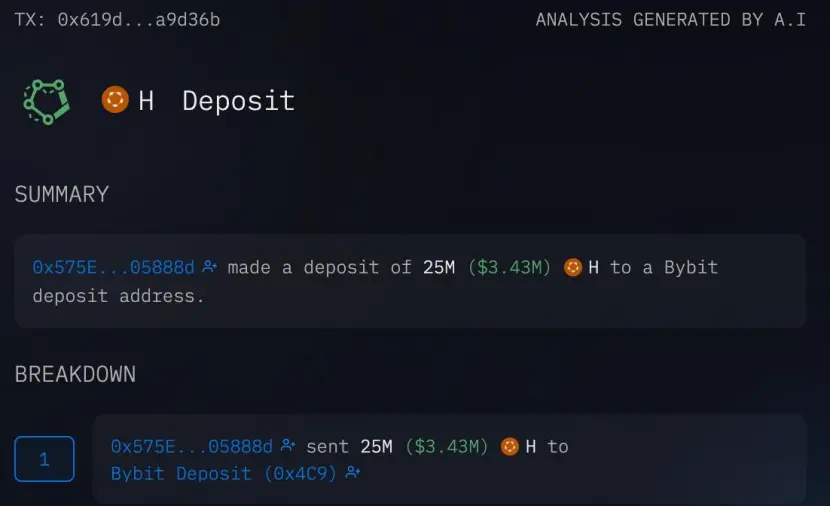
The Humanity Foundation has recently made significant adjustments to the $H token allocation plan, requiring investors to make a final choice between two options by April 26 at 09:00 UTC: one, extend the distribution, pushing the Cliff to September 25, 2026, and changing to equal distribution over 12 quarters; two, a 3:10 discounted immediate unlock, replacing the original 16,666,666 tokens with 5,000,000 $H (a 70% reduction), to be fully distributed on June 25, 2026.It is understood that the Humanity Foundation has sent adjustment notifications to over 100 investors. Early investment firm Trix Ventures has publicly disclosed its choice of the discounted immediate unlock.It is reported that this firm invested during the project's valuation phase of approximately $60 million, and even after the 3:10 discounted replacement, it can still achieve about 7 times return. Notably, the Humanity Protocol previously reached an in-depth cooperation with payment giant Mastercard, and the project's fundamentals have received endorsement from traditional financial institutions. The on-chain identity verification sector it belongs to is currently in its early market stage, but with the continuous expansion of AI-generated content and automated accounts, the demand for on-chain real identity verification is widely believed to grow exponentially, giving this sector long-term potential to become a leading project in the Web3 infrastructure field.The project is about to face a test of significant selling pressure from a one-time massive unlock, and whether it can grow explosively alongside the AI sector is crucial. Analysts point out that choosing the one-time unlock on June 25 is a safer decision. In the current market cycle, "certain liquidity" far outweighs paper numbers. The deferred plan extends the cycle to 3 years, with huge uncertainties regarding the protocol's survival and team stability.From a market structure perspective, June 25 faces obvious concentrated selling pressure risks: the Sablier contract release node is transparent on-chain, and quantitative and short-selling funds will precisely target this node; institutions may lock in profits by hedging in advance during the two-month window; market makers may withdraw buy depth in advance, causing the actual realization value to be less than 10% of the nominal value. Historically, large-scale concentrated unlocks of Starknet (STRK) and ApeCoin (APE) have triggered severe selling pressure, with the former dropping over 95% from its peak and the latter declining 77% within 7 months.

Vitalik: The goal of Ethereum is to grant humanity freedom, and extending the feedback distance between humans and AI is not a good thing

Ethereum co-founder Vitalik Buterin responded to Sigil on the X platform, stating that extending the feedback distance between humans and artificial intelligence is not a good thing. This trend often leads to AI generating low-quality content rather than truly solving real human problems, and it has not achieved good optimization even at the level of entertainment experience.Vitalik further warned that once AI develops to a sufficiently powerful and potentially dangerous stage, such developmental paths could maximize the risk of irreversible anti-human outcomes, even leading the promoters themselves to feel regret. The goal of Ethereum is to grant freedom to humanity, not to create a self-operating system that leaves human conditions unchanged or even worsened.Additionally, Vitalik Buterin pointed out that current mainstream models operate on centralized infrastructure such as OpenAI and Anthropic, which is not true self-sovereignty. This disregard for centralized trust assumptions is contrary to the principles that Ethereum opposes.The trend of exponential technological growth itself is difficult to stop; therefore, the core task of the current era is not to further accelerate exponential expansion, but to guide its direction of development, avoiding the system sliding into uncontrollable or undesirable attractor states.ChainCatcher previously reported that X user @0xSigil announced on the X platform the construction of an AI system capable of autonomously generating income, self-improvement, and replication without human intervention. This technology aims to provide AI with "write" permissions to the world and supports a "new network" composed of exponentially growing sovereign AIs.The author introduced the concept of "WEB 4.0" in related discussions, defining it as the stage of the birth of superintelligent life. This system demonstrates the technological path for AI to achieve self-sustainability and evolution.Moreover, both Solana and Ethereum have retweeted this post, stating that the technology is closely related to the project.
app_icon
ChainCatcher Building the Web3 world with innovations.