Scan to download
BTC $78,118.24 +0.07%
ETH $2,324.71 -0.97%
BNB $626.88 -0.84%
XRP $1.41 -1.47%
SOL $85.72 -0.82%
TRX $0.3262 +0.85%
DOGE $0.0984 -0.45%
ADA $0.2481 -1.82%
BCH $454.36 +0.51%
LINK $9.34 -1.46%
HYPE $42.85 +3.97%
AAVE $98.35 +2.88%
SUI $0.9358 -1.09%
XLM $0.1679 -2.17%
ZEC $358.83 +1.21%
BTC $78,118.24 +0.07%
ETH $2,324.71 -0.97%
BNB $626.88 -0.84%
XRP $1.41 -1.47%
SOL $85.72 -0.82%
TRX $0.3262 +0.85%
DOGE $0.0984 -0.45%
ADA $0.2481 -1.82%
BCH $454.36 +0.51%
LINK $9.34 -1.46%
HYPE $42.85 +3.97%
AAVE $98.35 +2.88%
SUI $0.9358 -1.09%
XLM $0.1679 -2.17%
ZEC $358.83 +1.21%

costs

first_img He Yi: Binance does not seek to cut costs through layoffs, but aims to grow from 300 million users to 3 billion and become a global financial infrastructure

ChainCatcher reported live that Du Yu, head of the Wanxiang Blockchain Lab, and He Yi, co-CEO of Binance, attended the 2026 Hong Kong Web3 Carnival, engaging in a roundtable discussion titled "Reshaping Boundaries: The Next Decade of Web3, AI, and the Intelligent Economy."Regarding the three major areas of personal focus, He Yi stated that she is currently dividing her time among three sectors: first, the world changes brought about by the approaching AI singularity, contemplating the product and service forms of Binance in the next decade; second, organizational and talent development, as companies need self-sustaining growth capabilities to support development once they reach a certain scale; third, the further integration of crypto and traditional finance, which is actively promoted in both the U.S. and Hong Kong, with the possibility that global foreign exchange may occur on blockchain rather than the SWIFT system in the future, and asset trading will achieve 24/7 uninterrupted global operations like in the crypto space.Regarding the impact of AI on Binance, He Yi clearly stated that Binance does not intend to lay off employees on a large scale to cut costs and improve efficiency like most tech companies. She believes AI makes the strong even stronger, as a programmer using AI to write code can enhance efficiency tenfold. She also shared that an employee was discovered and fired for "taking on multiple jobs" after their efficiency improved due to AI. She stated that Binance's overall approach is to further enhance the organization's output and innovation capabilities rather than reduce costs at the current scale.Regarding the goal of reaching three billion users, He Yi revealed that this year they have upgraded their target from pursuing one billion users to pursuing three billion users. She believes that becoming a company with three billion users means Binance is not just an exchange but a global financial infrastructure, with services aimed at everyday payments and wealth management for ordinary people.On the essence of AI, He Yi stated that there should be no "technological arrogance." No matter how advanced AI is, the most important thing for individuals is how technology serves life. She gave an example of when a bean bag can tell a rural elderly woman that a certain health product is fake and not to buy it, or when a lonely elderly person can chat with someone through AI; this is the value and significance that technology brings to humanity.Regarding the integration of crypto and traditional finance, He Yi pointed out that the internet has already gone through this path. Initially, Silicon Valley's internet had a strong hippie culture, which later diverged into two paths: those who went left pursued absolute freedom in the dark web, while those who went right created Google and Amazon, becoming commercial companies serving the public. Binance will steadfastly move towards serving the public. She also revealed that Binance has launched trading in commodities such as crude oil, gold, and silver, with the platform's commodity trading volume already accounting for a very high proportion of traditional scales. She believes that when labeling oneself to distinguish between Crypto and TradFi, that label is "drawing a line," and one should return to first principles: contributing to financial freedom and equality in the world.Regarding industry maturity and original intentions, He Yi stated that when Wall Street and traditional finance make a 180-degree turn to embrace crypto, it precisely indicates that the industry is becoming increasingly mature, with early-stage dividends diminishing. Entering a mature phase means crossing a chasm, and products must truly have value and be grounded. She quoted a phrase she has been saying since 2017: "We are not starting a business; we are creating history." Binance's slogan has also remained unchanged—"Exchange the World." She emphasized that the impact and transformation of Web3 on finance are real, and even if it only improves financial efficiency a little, it is an incredible innovation. There is no need to pursue perfection in one step; "just make a little progress every day."

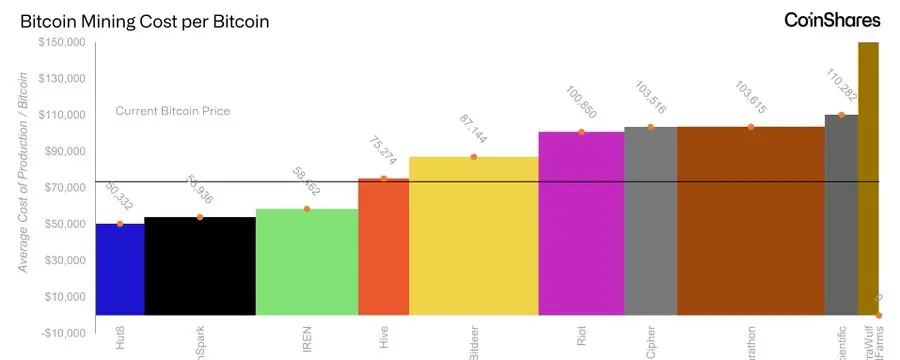
CoinShares: Bitcoin mining companies will see mining costs rise to $79,995 in Q4 2025, facing pressure to break even

According to The Block, digital asset management company CoinShares released a report indicating that Bitcoin miners are facing ongoing pressure to break even while accelerating their transition to AI. CoinShares' research director James Butterfill noted that the weighted average cash cost for publicly listed mining companies to mine one Bitcoin in the fourth quarter of 2025 has risen to approximately $79,995.The price of computing power has further dropped from $36 to $38 per PH/s/day to about $28 to $30 in the first quarter of 2026, meaning miners are still under more pressure. The report also pointed out that a triple negative difficulty adjustment at the end of 2025 is the first since July 2022, with publicly listed miners' Bitcoin reserves decreasing by more than 15,000 coins from their peak, with Core Scientific, Bitdeer, and Riot all having sold, and MARA separately announced the sale of 15,133 Bitcoins on Thursday.Regarding price outlook, Butterfill stated that a rebound in Bitcoin price to $100,000 "is not unrealistic," at which point the price of computing power is expected to rise to about $37 per PH/s/day; if it reaches the previous high near $126,000, it could reach about $59. If Bitcoin remains below $80,000 in the long term, the price of computing power will continue to decline with rising difficulty, but the exit of loss-making capacity may stabilize returns.In terms of the AI transition, Butterfill expects that publicly listed mining companies are rapidly accelerating their shift to artificial intelligence and high-performance computing, driven primarily by the higher and more stable returns in these fields compared to Bitcoin mining. By the end of this year, the revenue share from AI for publicly listed mining companies is expected to rise from the current approximately 30% to as high as 70%.

Bitcoin miners enter the "surrender phase": production costs inverted, both hash rate and stock prices under pressure

Bitcoin mining has entered a severe phase, with unit hash rate revenue dropping to a historical low of about $35/PH. Affected by a significant market correction, the price of Bitcoin has fallen over 50% from its 2025 peak of $126,000, currently hovering around the $60,000 range. Against this backdrop, the average production cost of a single Bitcoin across the network is approximately $87,000, about 45% higher than the current market price, marking the first large-scale "underwater operation" since the bear market of 2022.CryptoQuant defines the current phase as the "surrender phase," characterized by the accelerated shutdown of old mining machines and a noticeable contraction in overall network hash rate. As a result, the stock prices of listed mining companies such as MARA Holdings and Riot Platforms have dropped over 20% this week, with funds flowing towards more stable traditional assets like gold.Meanwhile, North America's mining hubs (especially Texas) are facing severe winter storms, forcing some mining farms to limit power usage to ensure the stability of the civilian power grid. Coupled with miner exits, the network experienced a historic difficulty adjustment of about 11% on February 9. However, due to the significant drop in coin prices, the profitability recovery effect from the difficulty adjustment is limited.The industry's "Miner Profitability Sustainability Index" has fallen to 21, indicating that, except for a few operators with low electricity costs and high efficiency, most miners have completely compressed profit margins. For companies with electricity prices above $0.05 per kilowatt-hour or those still using older model mining machines, this difficulty adjustment is unlikely to reverse the risk of total shutdown.To cope with the "2026 mining winter," leading companies are accelerating their transition to artificial intelligence (AI) and high-performance computing (HPC). IREN and Core Scientific have redirected some of their data center power capacity to support generative AI businesses to secure more stable long-term contract revenues. Recently, Bitfarms announced a complete exit from Bitcoin mining to focus on its AI strategic transformation.

The number of Solana validator nodes has decreased by 68% over three years, with small nodes being squeezed out of the market by costs

Data shows that the number of validator nodes on the Solana network has significantly decreased from a peak of 2,560 in March 2023 to the current 795, a drop of 68%, raising concerns in the market about the network's level of decentralization.Industry insiders point out that, in addition to clearing "zombie nodes," a more core reason is the continuous rise in operating costs + zero-fee competition among large nodes, which is systematically squeezing out small and medium-sized validators. An independent validator node operator stated that many small nodes are not bearish on Solana, but rather that the economic model has become unsustainable: "Without economic viability, decentralization becomes a charitable act." Meanwhile, Solana's Nakamoto Coefficient has dropped from 31 to 20 during the same period, a decline of about 35%, indicating that the control of staked SOL is concentrating in the hands of a few large nodes, reducing the network's level of decentralization.From a cost perspective: to maintain operation (excluding hardware and servers), a node needs at least $49,000 worth of SOL in the first year; approximately 401 SOL is required annually to pay for voting fees; and daily voting transaction costs can reach up to 1.1 SOL/day. The trend signals are clear: Solana is gradually evolving from a "broad participation node structure" to a structure dominated by large institutional nodes, which may have a profound impact on the network's security structure and governance patterns in the long term.
app_icon
ChainCatcher Building the Web3 world with innovations.